The Crisis of Muslim Education: From Early Childhood & Islamic Schools to Higher Education
The Center for Global Muslim Life is an America’s rooted, global Muslim & Decolonial publication discussing spirituality, education, politics, cities, social impact startups, and the arts & culture of the heart. We are a Reader Supported Nonprofit Publication, please click here to donate.
Introduction — The Crisis of Muslim Education
Two and a half years into the genocide against the people of Gaza, the institutions of western liberalism have made it clear to us what they actually think about Muslims. Gone are the fake language and brochures of DEI initiatives with a hijabi student in every photo. Now as we hear these institutions speak about social justice being a central part of their ethos, we understand that this is double speak, and is only true as long as it doesn’t impact their endowment, and the desires of a small group of legacy alumni who have even gone so far as to ban the critical usage of the term Zionism on campuses like New York University.
What began with the clear COINTELPRO program against Sami Al-Arian in 2003 & Ward Churchill in 2005 at the University of Colorado-Boulder where he was fired for protected political speech, has now been normalized. With at least 11 full professors being fired from their universities for protected speech since 2023 for speaking up about Palestine across the country and departments who have shown support for Palestine have had their funding cut or in the cases of some smaller programs they paused their programs and faced academic review. This is a broad crisis of education in the United States as education becomes further privatized and universities are focused on making money and are no longer about supporting students in becoming better humans. We are far from the time of Fatima al Fihri as she fasted for two years straight as her school Al-Qarawiyyin mosque and university in Fez, Morocco was being built in 859 CE, as the first public university in the world.
Part One: The Abandoned Foundation — Early Childhood Education and the Resource Crisis
Educators know that early childhood education represents perhaps the most critical years in preparing children for success, yet Muslim communities across the United States face a devastating resource gap in these foundational years. Between birth and age five, children’s brains are in their most flexible state, uniquely suited to learn languages, develop executive function, and establish the neural pathways that will shape their entire lives. This is when neuroplasticity is at its peak, when exposure to multiple languages literally changes brain structure, increasing grey matter in areas responsible for memory, attention, and cognitive control.
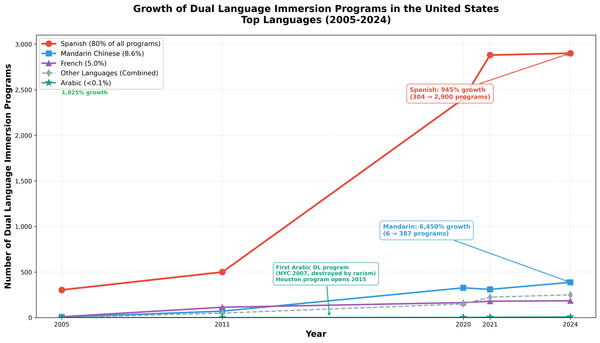
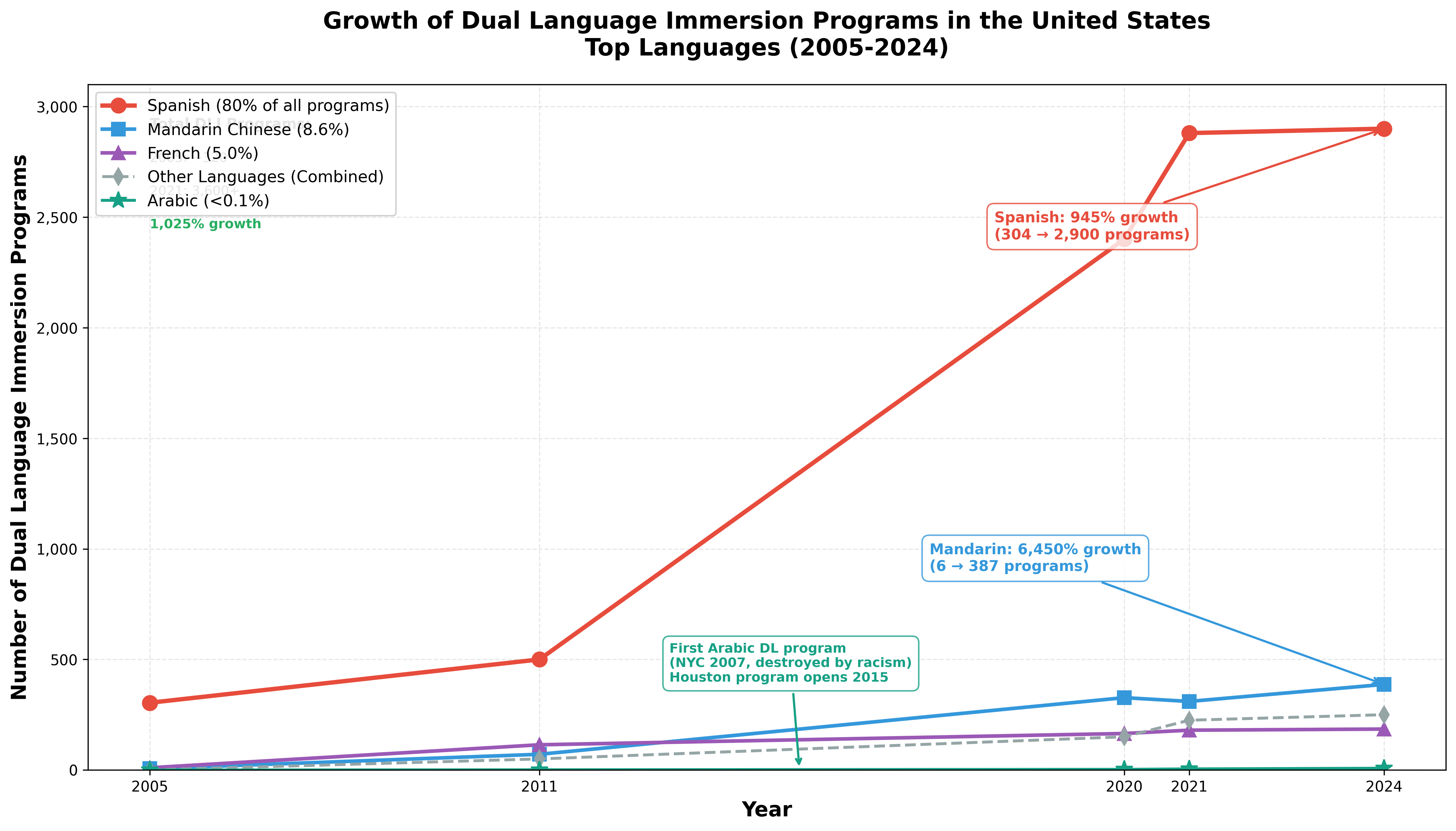
Spanish immersion preschools (representing 80% of all dual language immersion programs) continue to expand across the US having grown from 300 programs in 2005 to more than 3000 schools today. Mandarin immersion programs (nearly 400 schools nationwide), and French immersion options (173 programs across 34 states), it is almost impossible to find an Arabic immersion daycare, let alone a bilingual Islamic preschool.
Despite Arabic becoming the fastest-growing language in the United States, with Arabic-speaking English learners rising to become the second-largest group in K-12 schools nationwide—their numbers increasing 75 percent to reach 122,000 students by 2017 and 130,900 by 2021—there are virtually no Arabic dual language immersion programs in the country. The first Arabic dual immersion program, New York City’s Khalil Gibran International Academy, opened in 2007 but was systematically destroyed through coordinated Islamophobic attacks that forced the founding principal to resign and led to the dismantling of its dual-language curriculum. Eight years later, when Houston’s Arabic Immersion Magnet School opened in 2015 as one of the few Arabic dual immersion programs to survive, the principal was met by protesters waving American flags and Islamophobic signs.
Meanwhile, research demonstrates that bilingual children consistently outperform monolingual peers on tasks related to executive functioning including attention control, working memory, and cognitive flexibility. Studies at Cornell’s Language Acquisition Lab show that children who learn a second language can maintain attention despite outside stimuli better than children who know only one language. A 2004 Michigan State University study found that bilingual youth were more successful at complex problem-solving tasks, suggesting the bilingual experience strengthens the brain’s command center. Learning a second language can even protect against Alzheimer’s, delaying the disease by an average of four years compared to monolinguals.
Yet Muslim families have almost no access to these scientifically-proven early childhood models. We lack Arabic immersion daycares. We lack halal food options in existing childcare centers. We lack early childhood programs rooted in the worldview of Islam. We are forced to choose between secular programs that ignore our values or underfunded, makeshift arrangements that barely survive.
The Rose Garden: Bridging Islamic Pedagogy and Arabic Immersion in the Bay Area
In Fremont, California, The Rose Garden represents a quietly revolutionary approach to early childhood Islamic education—one that understands what mainstream American educational institutions refuse to acknowledge: that language acquisition happens most naturally in the first years of life, and that Arabic immersion for Muslim children is not a luxury but a necessity for accessing their own spiritual and intellectual heritage.
Founded by Sana Jalili, who was trained in both Western progressive methodologies and classical Islamic pedagogical traditions, The Rose Garden operates as an urban farm preschool where “the classroom is an urban farm and falling in love with Allah leads the way.” This is not the sterile, factory-model Islamic school copied from public education. Instead, it represents a return to an older, more holistic vision, one where children learn Arabic not as a foreign language class squeezed between math and science, but as the living language of their faith, taught outdoors among Allah’s signs in creation.
The founder’s credentials reveal a deliberate synthesis of East and West. As shown in their curriculum overview, the program integrates training from the Muslim world—including Prophetic Tarbiyyah studied in Syria and Jordan, the An-Nur curriculum by Maha Shahada, and critically, the Hud Hud Arabic immersion curriculum, with Western progressive education models including Waldorf training, AMS Montessori certification, and Islamic pedagogy frameworks developed by scholars like Recep Senturk.
The Global Arabic Immersion Model
What makes The Rose Garden’s approach significant is its connection to a broader global movement of Arabic immersion education that has flourished in places like Turkey and Syria, even as it has been systematically suppressed in the United States. While American Muslim communities struggle with virtually no Arabic dual language immersion programs, educators in Turkey, Syria, Jordan, and other parts of the Muslim world have developed sophisticated Arabic immersion models specifically designed for young children.
The Hud Hud curriculum, which The Rose Garden’s founder studied directly with its developers, represents one of these models. The Hud Hud immersion model is a part of a tradition of Arabic immersion pedagogy that has been refined in places like Damascus, Amman, and Istanbul, cities where Arabic language education for children has never been seen as controversial or threatening, but rather as natural and necessary.
In Turkey, even amid the Syrian refugee crisis, educators recognized the importance of maintaining Arabic language instruction for children. Temporary education centers established for Syrian refugee children utilized Arabic as the medium of instruction while also teaching Turkish, understanding that bilingualism strengthens rather than weakens children’s cognitive development. These programs, documented by UNICEF and Turkish education authorities, demonstrated that it is entirely possible to create thriving Arabic immersion environments even in non-Arabic speaking countries.
Qatar Foundation International: The Only Lifeline for Arabic Education in America
In a landscape where Arabic-speaking students represent the second-largest English learner population in U.S. K-12 schools, 130,900 students as of 2021, yet have access to fewer than 10 dual language immersion programs nationwide, one organization has emerged as virtually the sole institutional force working to expand Arabic language education: Qatar Foundation International (QFI).
Founded in 2009, QFI began Arabic language programs at partner high schools in Boston and Washington, D.C., expanding to support 22 schools in North America and 8 in Brazil by 2015, reaching over 2,100 students, with programs in 29 jurisdictions across the United States and Canada. Based in Washington, DC, QFI is an educational organization committed to advancing Arabic language teaching and learning, supporting innovative, research-based Arabic language programs in state-funded primary and secondary schools to increase access to Arabic instruction for educators and students around the world, currently operating in Austria, Canada, Germany, Ireland, the United Kingdom, and the United States.
This support extends beyond funding to include comprehensive infrastructure development for Arabic education: teacher training and certification programs, classroom enrichment grants, professional development workshops, Arabic teacher councils in major cities, and student exchanges to Qatar. QFI’s support proved critical in helping establish some of the few Arabic dual language immersion programs that have survived, including programs in New York City and Houston—coming years after the nation’s first Arabic dual language program, Brooklyn’s Khalil Gibran International Academy, was destroyed through coordinated Islamophobic attacks in 2007.
The Houston Model: QFI’s Flagship Investment
QFI contributed $85,000 to Houston Independent School District to help train teachers and develop curriculum for the Arabic Immersion Magnet School, which opened in 2015, having previously provided funding to HISD for Arabic programs at Lee High School and Bellaire High School. The school represented a critical milestone, one of the first Arabic dual language immersion programs to survive in a post-Khalil Gibran era.
According to QFI Executive Director Maggie Mitchell Salem, the foundation’s mission aligns with HISD’s goal: “to prepare students as global citizens,” arguing that “this isn’t just a nice thing to do. It’s a necessary thing to do. To be internationally competitive, students have to understand how to work in different environments.” She pointed out that Arabic is the fourth most popular language in the world and the third most common language in HISD after English and Spanish.
Learning from Indigenous Resilience: The Hummingbird Model
To understand what a values-rooted, community-centered approach to supporting families during these critical early years looks like, we can learn from Hummingbird Indigenous Family Services in Seattle. Founded in 2018 by clinical social worker and Indigenous doula Camie Jae Goldhammer, Hummingbird launched “The Nest” in August 2023—the first guaranteed income program in the United States specifically serving Native communities.
The program provides 150 pregnant Indigenous people (American Indian, Indigenous of the Americas, Alaska Native, Native Hawaiian, or Pacific Islander) with $1,250 per month, no strings attached, from pregnancy through their child’s third birthday. Families may receive as much as $45,000 by the time they exit the program. But The Nest is not just about money, it’s about restoring dignity, abundance, and traditional values in the face of genocidal policies.
“Abundance is a traditional cultural value that has been lost due to relocation and genocide,” explains Tia Yazzie, Abundance Auntie with Hummingbird. “The Nest supports families in reclaiming abundance for Indigenous families. Our relatives know that they are cherished, supported and entitled to a future filled with health and well-being. By providing guaranteed income, we are telling them that they are enough, that they are valuable by their very nature.”
The program exists because of stark realities: American Indian and Alaska Natives in Washington experience a maternal mortality rate seven to eight times greater than white people, with 80% of these deaths preventable. Six percent of King County’s Native population is homeless. Native infants die at rates more than three times the county average.
Hummingbird’s approach combines guaranteed income with doula services, home visits, lactation counseling, and community events that promote critical bonding time, all rooted in Indigenous culture, healing practices, and the spirit of abundance. This is structural intervention based on values, not just broken models of charity.
For Muslim communities, the lesson is clear, we need comprehensive support systems for families during pregnancy and the first three years of life. We need guaranteed income pilots for Muslim families. We need Arabic immersion preschools with halal food and Islamic values integration. We need doula services rooted in Islamic tradition. We need to stop accepting scraps and start building institutions that reflect the principle that every child is born in a state of fitrah and deserves to be nurtured in an environment that honors that sacred trust.
Part Two: Using the Masters Tools — Islamic Schools Replicating Failure of the US Public School System
“For the master’s tools will never dismantle the master’s house. They may allow us temporarily to beat him at his own game, but they will never enable us to bring about genuine change.” - Audre Lorde
Our children are under attack by the internet that occupies their minds, if we cannot give them spiritual training (tarbiyyah) that occupies their souls, and if Islamic schools are focused mostly on identity then we have already lost the battle. The majority of Islamic schools today are scraping by with underpaid teachers and curriculum models copied directly from public schools. These institutions face immense pressure: limited resources, parent expectations focused on Ivy League admissions, competition with elite private schools, and the constant threat of closure. In response, most Islamic schools have made a tragic choice: they have decided to replicate the very system that was designed to destroy us.
Walk into most Islamic schools in the United States and you will find: standardized test prep dominating instruction, AP classes prioritized over Islamic Studies, college admissions counseling more robust than spiritual formation programs, STEM focus overwhelming humanities, and Islamic Studies and Quran classes treated as add-ons rather than the foundation. The message we send our children is clear: Islam is important, but not as important as getting into Stanford.
This represents a fundamental crisis of vision. We have allowed the metrics of a secular, materialist society to define success for our children. A student who memorizes half the Quran but doesn’t get into an elite college is seen as a failure. A student who gets into Harvard but barely prays is celebrated. We have internalized our oppression so deeply that we now oppress ourselves.
The result is that Islamic schools, with rare exceptions, function as Islamic-flavored prep schools for entry into the American professional class. They provide a safe space for Muslim students to wear hijab without harassment and to pray during the school day, but they do not provide a transformative Islamic education. They do not produce students who understand Islam as a complete way of life, who have studied Islamic philosophy and theology deeply, who can read classical Arabic texts, who are prepared to be scholars and leaders guided by Islamic principles.
Most tragically, Islamic schools have failed to develop authentic Islamic pedagogy. We teach Islamic Studies the way public schools teach social studies, as disconnected facts to be memorized. We teach Quran recitation without deep engagement with meaning. We teach Islamic history as a series of battles and dynasties rather than as intellectual and spiritual movements. We have books and buildings, but we have lost the soul of Islamic education.
The crisis is deeper still: most Islamic schools cannot afford to pay teachers living wages, leading to constant turnover and the hiring of teachers without Islamic knowledge or commitment. Many schools lack proper Arabic language instruction as we have already covered, ensuring students graduate unable to engage with Islamic texts in their original language. Few schools offer advanced Islamic Studies courses comparable to AP-level academic rigor. And almost no Islamic schools have developed early childhood programs rooted in Islamic principles of development and learning.
Compare this to the elite private schools where wealthy Americans send their children. These schools use diverse progressive models of education to understand the intellect, emotions, and physical well-being of their students—all with the goal of producing the next generation of leaders. They have nature-based learning, arts integration, social-emotional development programs, and low teacher-student ratios. They are not scrambling to prove their graduates can get into good colleges; they are confident their approach produces capable, thoughtful leaders.
Islamic schools need a revolution, or what Recep Senturk has called a rooted revival within the holistic system of Islamic epistemology. As Dr. Senturk has written,
“Existing educational frameworks and curricula are simply too rooted in worldviews and values that are not entirely compatible with a traditional Islamic view of reality nor are they consistent with the richness and complexity of reality itself. Existing curricula utilize secular philosophies that are dismissive of non-material realities and are thus reductionist. This has created an untenable situation for humanity.
Presently, there is a clash between modern and postmodern approaches in the world with explicit ramifications for education. Yet, when closely examined from an Islamic perspective, this clash is superfluous. Therefore, Muslims have the potential to offer a new perspective to go beyond this dichotomy.
Multiplex progressive values based education goes beyond the false dichotomies created by modern and postmodern materialist perspectives to education. However, it doesn’t completely reject their insights and gains if they are empirically grounded and proven to be useful. This is because multiplexity allows treating these existing reductionist perspectives as valid on a particular level or from a certain perspective, thereby including them within a more comprehensive and holistic multiplex framework.”
We need to stop measuring success by college admissions and start measuring it by spiritual development, ethical formation, and intellectual depth. We need to pay teachers properly and invest in their Islamic and pedagogical training. We need to develop authentic Islamic curriculum rather than buying secular curriculum and slapping Islamic content on top. We need to create Arabic immersion tracks from preschool through high school. We need to stop apologizing for centering Islam and start building institutions that reflect our values unapologetically.
Part Three: The Factory of Conformity — Public Schools and the Illusion of Progress
In public schools, any remnant of virtue-based education is gone. This system, designed over a century ago to train young people for factory work that no longer exists, now focuses on performative identity politics rather than any consideration of what it takes to raise ethical human beings. Visit almost any public or private school in the United States today and you see Black Lives Matter murals and the language of social justice plastered on walls. But if a teacher voices their support for Palestine, they can be fired immediately. Then there are the western missionaries of progress who target our children with comments that most kids will not know how to answer.
We have a friend who teaches in public schools in the Pacific Northwest, a hijabi, who was assaulted by a male student in her classroom because of her views on Palestine. Rather than protect her, the district eventually fired her. This is the reality of “social justice” in American public education: it’s acceptable only when it doesn’t threaten the comfort of administrators or the prejudices of wealthy parents.
The crisis in public schools extends far beyond Palestine, though Gaza has made the contradictions impossible to ignore. Public education in the United States remains fundamentally rooted in the assimilationist model of the early 20th century. The goal was never to educate children to be better humans—, it was to integrate diverse immigrant populations into an “American” identity that meant the abandonment of language, culture, and values. For Muslim students, this means being told their hijab is a distraction, their prayer is an inconvenience, their fasting during Ramadan is “dangerous,” for their health.
The assault on Muslim students in public schools operates on multiple levels. There’s the obvious harassment from peers, the Islamophobic comments, the questions about terrorism. But more insidious is the structural erasure: curriculum that ignores Islamic civilization’s contributions to science, mathematics, and philosophy; history classes that treat Islam as a violent aberration rather than a world civilization; literature courses that never include Muslim authors; social studies units that frame Muslim-majority countries only through the lens of conflict and oppression.
Muslim students in public schools are taught to be ashamed of who they are, even as the school posts land acknowledgments and hosts Latinx Heritage Month assemblies. The message is clear: some identities deserve performative celebration, others deserve suspicion.
Part Four: The Endowment Over the Muslim Community — Private Schools and Higher Education’s Moral Bankruptcy
Elite private schools see the value of Muslims within their institutions, but much like universities fixated on endowments, these schools must negotiate between legacy donors and desires for diversity. Muslim students at elite private schools and universities serve a function: they provide the optics of inclusion while their actual concerns are dismissed.
The last two and a half years have revealed this with brutal clarity. Students at Columbia, Harvard, Yale, Princeton, NYU, and across the country stood up for Gaza and were met with suspensions, arrests, academic probation, and alumni-funded doxxing campaigns. University presidents were hauled before Congress to discuss anti-semitism, but no one asked about the actual genocide being funded by these universities’ endowments. Students who occupied buildings in protest of apartheid were painted as antisemitic terrorists, while universities maintained investments in weapons manufacturers and companies profiting from occupation. Many of these students are no languishing in ICE detention facilities across the United States.
Professors have been fired for social media posts supporting Palestine. Entire departments have faced funding cuts for statements criticizing Israel. Job offers have been rescinded. Tenure reviews have been weaponized. The message sent is clear: academic freedom exists until it threatens the interests of wealthy donors, most of whom support Israel unconditionally.
Muslim students on these campuses report feeling betrayed. Many applied to elite universities believing in the rhetoric about social justice, critical thinking, and speaking truth to power. They thought these institutions meant what they said about equity and inclusion. Gaza revealed this as performance. DEI offices that hosted iftar dinners suddenly went silent on Palestine. Administrators who posted land acknowledgments refused to acknowledge occupation. Professors who taught critical race theory couldn’t bring themselves to apply that analysis to Zionism.
The crisis extends beyond Palestine to the fundamental purpose of higher education in America. Universities have become corporations focused on maximizing revenue, through tuition, research grants, and endowment growth. Education has become a commodity, students are customers, and knowledge is only valued if it can be monetized. The traditional purpose of a university, to pursue truth, to form ethical citizens, to preserve and transmit civilization, has been abandoned in favor of career training and credential distribution.
For Muslim students, this means navigating institutions that treat Islam as a diversity checkbox while maintaining structural Islamophobia. It means taking courses on “political Islam” taught by professors with clear ideological biases. It means watching Islamic Studies departments staffed primarily by non-Muslims who approach Islam as an object of study rather than a lived tradition. It means being told to integrate and assimilate while watching institutions celebrate every other form of diversity.
Muslim parents spend hundreds of thousands of dollars to send their children to these institutions, believing this is the path to success but at what cost to their deen, their sense of self, their connection to the ummah?
We need alternatives. We need to build Islamic universities that rival the elite private institutions in academic quality but remain rooted in Islamic values and purpose. We need to create pipelines from Islamic schools to Islamic higher education. We need to invest in Islamic scholarship and research institutions. We need to stop accepting crumbs from universities that despise us and start building institutions that honor us.
This is not a call to abandon secular higher education, many Muslims will continue to pursue education at mainstream universities, and that is fine. But we need options. We need institutions where Muslim students can pursue rigorous academic training without compromising their faith, where Islamic Studies is taught by committed Muslim scholars, where the purpose of education is to serve Allah rather than to maximize earning potential.
Conclusion: The School of the Ummah Model
To transform this deep state of crisis we are launching the School of the Ummah model. The School of the Ummah is a transformative education initiative that builds deep community in response to the crisis of Muslim education in the United States and around the world. Our critical interventions are focused in six primary areas:
- Through interactive community workshops what we are calling Future Ummah Builders—bringing together parents, educators, and community members to reimagine Muslim education from the ground up.
- Year-long youth leadership development programs focused on transitional education years: fifth and sixth grades, ninth grade, 12th grade, and the first year of college—the critical moments when students need support most.
- Through Arabic immersion and bilingual education programs starting in early childhood education in preschools and daycares—because language is the key to accessing our tradition, and the first five years are when the brain is most capable of acquiring it.
- Through culturally relevant and Islamic-rooted curriculum development and publishing focused on Islamic schools and parents who homeschool—creating authentic Islamic pedagogy rather than secular curriculum with Islamic content added as an afterthought.
- If these above projects are successful, then we we will consider launching an online global Islamic high school, as a culturally relevant, college preparatory hub, rooted in the Islamic spiritual tradition, providing an alternative to both failing public schools and assimilationist Islamic schools.
If we are to change our condition as a community, we must reflect deeply on the goals of education for us as Muslims. Most Islamic schools today are carbon copies of the U.S. public education system designed a century ago to send students into factory careers that no longer exist and to integrate diverse populations into the American dream, which we know has been a nightmare for much of our community.
The primary goal of most Muslim parents in educating their children is not for them to know Islam, but to know how to become a doctor, lawyer, engineer, or anything that will allow us to live up to capitalist fantasies that we have been brainwashed by.
Meanwhile, at elite private schools in this country, they use diverse progressive models of education to understand the intellect, emotions, and physical well-being of their students—all with the goal of producing the next generation of leaders of society.
So as Muslims with intentions of transforming our world, our intentions should be to raise a great generation of scholars and leaders with sound hearts. Our goals should be to end the military-industrial complex and unfettered capitalism that are destroying our world, while building a world reflective of our faith and beliefs—as the great Syed Naqib Al-Attas has named it, within the Worldview of Islam.